The band
Five people from a cannery town who stayed and made the staying into art.
Daughter of a Bering Sea crabber, lost to a November storm when she was fourteen. Dry as dock rope, fiercely loyal, allergic to sentimentality — she writes the blood, argues it out with Silas, and the songs are the compromise. Refuses to write lyrics on a phone; carries a waterproof field notebook, currently on volume four.
Two years into a UW marine biology PhD studying deep-sea amphipods when the grant evaporated; now a marine electrician on the docks — “I still study the ocean, I just bill hourly.” Brings actual papers to practice and names his pedals after deep-sea creatures. His fights with Wren are the band’s songwriting engine.
Former altar boy, current welder at Jensen’s Boatyard. The heaviest riffs in the band come from the gentlest person in the band, and nobody has ever successfully explained this. Bakes sourdough — the starter is named Doug — and keeps a “riff jar” of 400+ voice memos labeled things like “angry boat.”
Ex-high-school linebacker who quit football the day he realized he liked the marching band’s halftime show more than the game. Sat in on bass at the Rusty Anchor when HADAL’s original bassist quit mid-set in 2020 and never gave the instrument back. The band’s social engine, comic relief, and — in the DMs, where it counts — the one who checks in on fans having a hard time.
Eight years as a Navy sonar technician on a fast-attack sub out of Bangor. Heard things on sonar he doesn’t talk about; the band’s mythology is built on what he won’t say. Speaks rarely and precisely — when Frankie says a lyric is right, it’s right. Rates restaurants by their ice machine hum.
The story so far
Port Vesper, Washington — pop. ~4,100 — a cannery town the canneries left twenty years ago.
HADAL practices in the Freezer: a decommissioned bait freezer at the back of the old Vesper Cannery, 38°F year-round, still faintly smelling of herring no matter what they do. They practice in parkas. The setlist is taped to the wall next to a 1987 tide chart, and every HADAL recording carries the Freezer’s compressor hum buried in the mix — Silas calls it “our sixth member.” Wren calls it “the landlord.”
The name came from Frankie, three practices deep, tapping a paradiddle on a bait crate: “On the boat, anything below crush depth we just called hadal. It’s the zone named after hell where things still live.” It stuck before anyone could object. Dez still claims he suggested it first. He did not.
- 2019 — Wren and Silas’s folk duo Vesperine dies in the harbor. Theo answers a flyer at the chandlery: “Guitarist wanted. Must tolerate cold and sadness. Bring your own parka.” First practice in the Freezer, November.
- 2020 — First show, VFW Hall matinee, 23 people; power outage mid-set, they finish acoustic by phone light. Dez picks up the bass after the Rusty Anchor incident. Frankie joins in August. The lineup has not changed since.
- 2021 — Self-recorded 4-track EP Soundings in the Freezer. The zine BARNACLE calls it “the sound of our town’s basement.” 200 hand-numbered copies, sold out at shows.
- 2022 — First regional run: Seattle, Portland, Astoria, Boise. The van — a ’94 Econoline named the Bathysphere that leaks in rain — survives.
- 2023 — The Boise breakdown: the Bathysphere dies; they play a laundromat to pay for the tow. Legend status in the scene. The first Descent material gets written in the Freezer that winter.
- 2026 — Descent releases. The trilogy begins.
Three-act journey
Each record follows the water column down — through light, through cold, through pressure — and finds something glowing at the bottom.
Leaving the surface world. Twelve tracks, each one deeper — sunlight, twilight, midnight, abyssal, hadal. The decision to stop treading water and go down on purpose: into grief, into the thing you’ve been circling. It ends at the trench floor, 10,935 meters down, with the first flicker of something glowing in the dark.
The bottom. The record that stays down there — pressure, darkness, and the strange life that glows. The confrontation with what lives at the bottom with you, and the discovery the research insists on: things thrive here. Heavier than Descent, and quieter in the middle — long ambient passages like sitting on the trench floor, listening to the water.
Coming back up — decompression stops, staged and mandatory, because surfacing too fast kills. The light hurts at first. Cautious hope with grief still in it: you don’t conquer the depth, you integrate it. The final track should feel like breaking the surface at dawn — not triumphant, just true.
Research receipts
The lyrics are built from real oceanography — every theme chosen because it hits a human nerve, not because it’s cool trivia.
- Hadal biology — the snailfish survives past 8,000 meters by being soft where everything else would shatter. Resilience isn’t hardness.
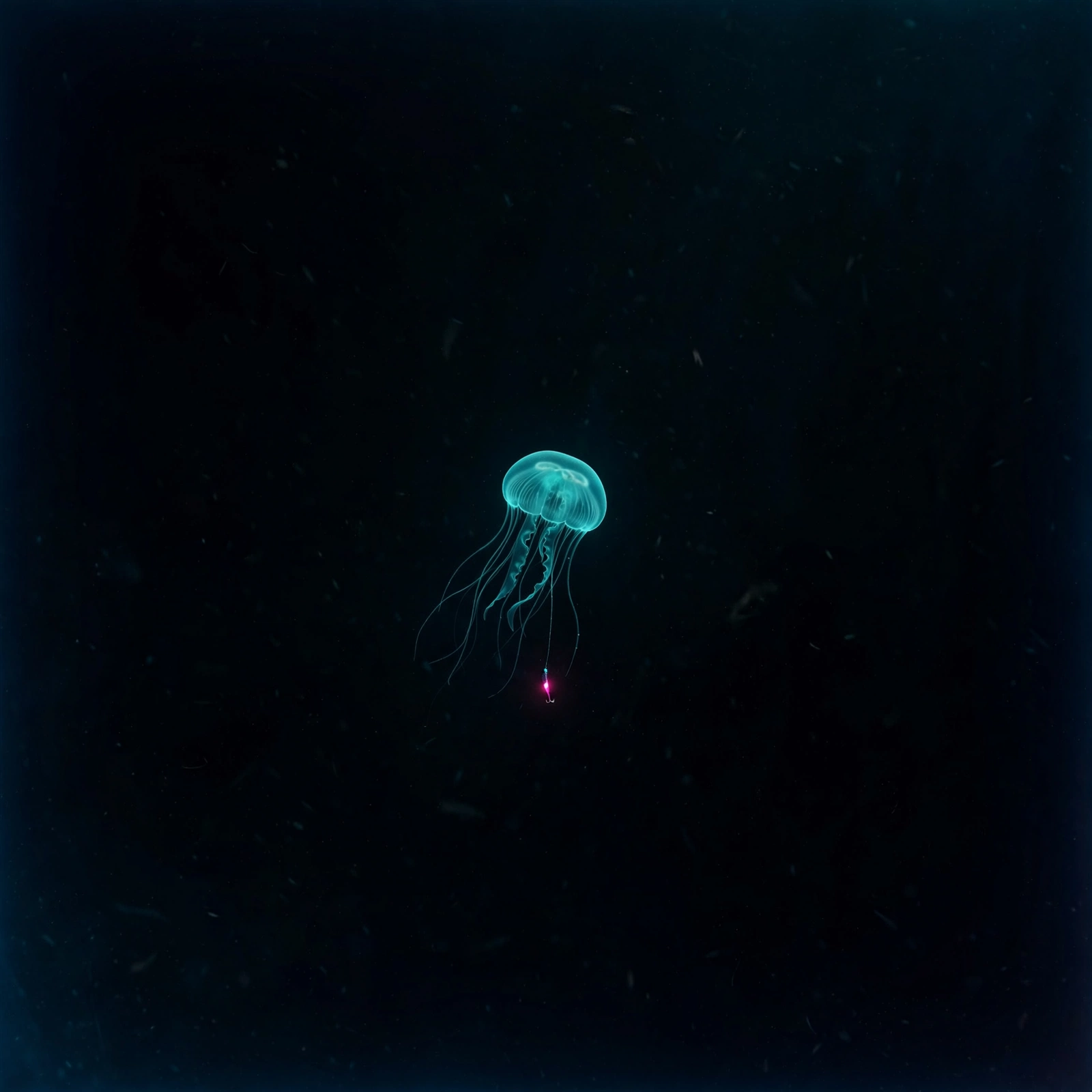
- Bioluminescence — in the deep ocean, most animals make their own light. Hope as a discipline, not a feeling: nobody is coming with a lamp.
- Submarine disasters — Thresher, Kursk, Titan: the difference between descending on purpose and being crushed by accident.
- Whale falls — one death feeds an ecosystem for decades. Grief as nourishment: your worst year fed someone; nothing is wasted, even this.
- Freediving — the danger isn’t the depth, it’s the ascent. Coming up too fast is what kills you.
- Decompression — the cure for the bends is going back down and coming up slowly, in stages. You cannot rush healing.
Fresh from the research sweep — October 2026
- The deepest fish ever filmed. A 2026 Japan Trench expedition filmed a snailfish feeding at 8,336 m — the deepest in-situ observation of a fish on record. Soft, scaleless, gelatinous: the pressure didn’t break it, it fed. IFLScience
- “Picking up rocks.” At NYT Climate Forward (Sep 25), The Metals Company’s CEO dismissed deep-sea mining risks as “picking up rocks” — while 46 countries call for a pause and a 1979 test site still shows no recovery 44 years later. Nodules grow millimeters per million years. Oceanographic Magazine
- A failed search found a reef. Off Argentina, a deep-sea expedition hunting cold seeps instead found the world’s largest known Bathelia candida coral reef, 28 candidate new species, and the country’s first filmed whale fall. Impactful Ninja
- Fifty-seven names for the dark. The Schmidt Ocean Institute’s October 1, 2026 announcement: 57 new species and five new genera from Argentina’s Mar del Plata Canyon — 20 copepods, 22 echinoderms, 14 cnidarians — named in two weeks by 20 taxonomists, from only ~10% of the samples collected. The standout: “Loki,” a horned translucent sea cucumber at 2,577 meters. Follow-up expedition planned for early 2027. Schmidt Ocean Institute / Ocean Census
- Below the last fish. A 2026 ZooKeys paper describes two new Princaxelia amphipods from the Tonga and Mariana trenches — one from boulder fields below 8,000 m, past the depth where fishes reach their limit and disappear entirely. Down there the amphipods aren’t scavengers waiting on falls. They’re the top predators. ZooKeys 1289
- Three new snailfish, one named for a place. MBARI described three new snailfish off California in Oct 2026 — bumpy, dark, and sleek. The sleek one, Paraliparis em, is named for Station M, watched for 30 years. MBARI
- Back to the test site. RV SONNE (SO322, Oct–Dec 2026) is revisiting the 2021 Clarion-Clipperton mining test site. Nodules grow 1–2 mm per million years; the chief scientist expects “likely, we will not see any recovery.” Phys.org
- Nine millimetres redraws a family. A new amphipod genus, Renomaera, from a seamount near the Mariana Trench — one eyeless 9.3 mm female, found with a sponge, carrying thirteen young, distinct enough to bend the family tree. And at 10,898 metres, "rock feather" foraminifera turn out to be eating pine pollen fallen from land trees: the surface feeds the dark without knowing it. Bioengineer
This is for…
The ones under pressure, learning to glow.
- The deep-enders — anyone who stopped treading water and chose the direction of the fall.
- The soft survivors — the ones who made it through by bending instead of breaking, like the snailfish.
- The lamp-keepers — tending a light almost no one will see, for ships that may never come.
- The slow ascenders — healing in stages, taking the mandatory stops, refusing to rush the surface.
“The kids aren’t alright” is someone else’s line. Ours is simpler: go down glowing.
The Logbook
Messages from the ones still standing.
The Logbook opens when Descent surfaces. Until then: the water is listening. When the record is out, leave your mark — signal reports, depth readings, proof you were down here too.
Coming soon